
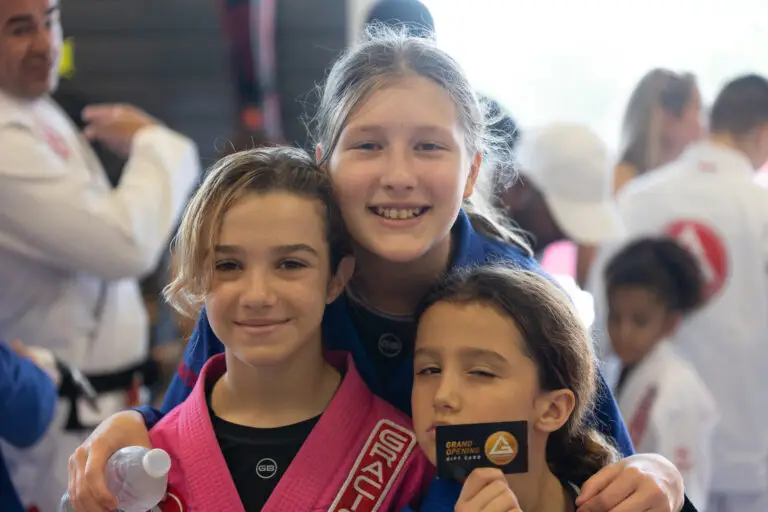
Kids BJJ Belt Order: Every Rank Explained
The complete kids BJJ belt system — what each belt means, how long it takes, and what your child is learning at every stage.
The kids BJJ belt system is different from the adult system — and for good reason. Children develop differently than adults, both physically and mentally, and the belt rankings in kids BJJ reflect that reality. Rather than pushing children through an adult framework, the IBJJF and Gracie Barra use a dedicated kids system that tracks progress in a way that's age-appropriate and genuinely motivating.
Here's the complete kids BJJ belt order, what each rank represents, and what parents can expect at each stage.
The Kids BJJ Belt Order
For children under 16, BJJ uses a separate set of belt colors:
- White Belt
- Gray Belt (Gray-White, Gray, Gray-Black)
- Yellow Belt (Yellow-White, Yellow, Yellow-Black)
- Orange Belt (Orange-White, Orange, Orange-Black)
- Green Belt (Green-White, Green, Green-Black)
Each of the colored belts (gray through green) has three sub-ranks, denoted by white, solid, and black tip variations. This gives children more frequent milestones — an important motivational tool that keeps young practitioners engaged through the inevitable plateaus of learning.
At age 16, a student with a kids belt transitions to the adult belt system. Depending on their skill level, they may receive a white, blue, or occasionally even a higher adult belt at that transition.
White Belt — Starting the Journey
Every child begins at white belt, regardless of age or prior athletic experience. White belt in kids BJJ focuses on:
- Basic movement patterns — falling safely, rolling, hip escapes
- Fundamental self-defense concepts
- Learning to follow instructor direction and work with a partner
- Building confidence on the mat
The primary goal at white belt is comfort. Kids need to feel safe and enjoy themselves before technical development becomes meaningful.
Typical duration: 3–6 months
Gray Belt — Building Fundamentals
The gray belt is the first promotion and a meaningful milestone. It signals that the child has internalized the basics and is beginning to develop real technique. The three sub-ranks (gray-white, gray, gray-black) provide stepping stones that keep kids motivated and give instructors a precise way to track development.
At the gray belt level, children are learning:
- Basic guard positions and how to work from them
- Fundamental escapes from bottom positions
- Simple submissions in controlled drilling
- Discipline, respect for training partners, and mat etiquette
Typical duration per sub-rank: 4–8 months
Yellow Belt — Growing Confidence
Yellow belt kids are noticeably more confident and competent on the mat. They can demonstrate basic techniques under light resistance, they understand positions, and they've developed the mindset that BJJ requires — calm problem-solving rather than panic or brute force.
The yellow belt phase is often where kids start to get genuinely hooked on BJJ. They're good enough to feel the satisfaction of executing a technique correctly, but still learning enough to stay challenged and curious.
Typical duration per sub-rank: 6–12 months
Orange Belt — Intermediate Practitioner
Orange belts are intermediate practitioners. They understand the fundamentals deeply and are beginning to develop a personal style. At this stage, instructors at Gracie Barra Davenport often notice kids starting to take on informal leadership roles — helping newer students, setting examples in class, and demonstrating the culture of the school.
Technically, orange belt students are working on:
- More complex guard games and sweeps
- Passing concepts with multiple options
- Submission chains and transitions
- Preparing for — and often competing in — youth BJJ tournaments
Typical duration per sub-rank: 8–14 months
Green Belt — The Highest Kids Rank
Green belt is the pinnacle of the kids BJJ system. A green belt can execute a wide range of techniques with confidence and understands the underlying principles of BJJ — not just individual moves, but how they connect and why they work. Green belt practitioners often function as role models in the kids program.
Green belt is relatively rare among kids, and earning it — let alone reaching green-black — is a genuine accomplishment that sets a child up well for transitioning into the adult system.
Typical duration per sub-rank: 10–18 months
What Does Gracie Barra Look for in Kids' Promotions?
At Gracie Barra Davenport, kids promotions reflect more than just technique. Our instructors evaluate:
- Attendance and consistency — showing up is the foundation
- Technical development — can they execute what they've been taught?
- Behavior on the mat — how do they treat partners, especially smaller or newer students?
- Attitude toward difficulty — do they persevere when it's hard?
- Growth as a person — are they becoming more focused, respectful, and confident?
Belt promotions are celebrated events at GB Davenport. We recognize the work children put in and make sure they feel the significance of each step forward.
How Long Does It Take for a Child to Earn a Green Belt?
Training 2–3 times per week consistently, a child who starts at age 5 might reach green belt by age 12–13. A child who starts at 10 might reach green by 14–15. The timeline varies significantly based on natural aptitude, training frequency, and how long a child has been in the program.
The more important question isn't how long it takes — it's what a child gains along the way. The discipline, resilience, focus, and confidence that kids develop through BJJ training are benefits they carry for the rest of their lives, regardless of belt color.
Enroll Your Child at Gracie Barra Davenport
We welcome kids starting at age 3 in our Little Champions program, with structured age-appropriate classes through the teen years. Get started here and we'll help you find the right class for your child.